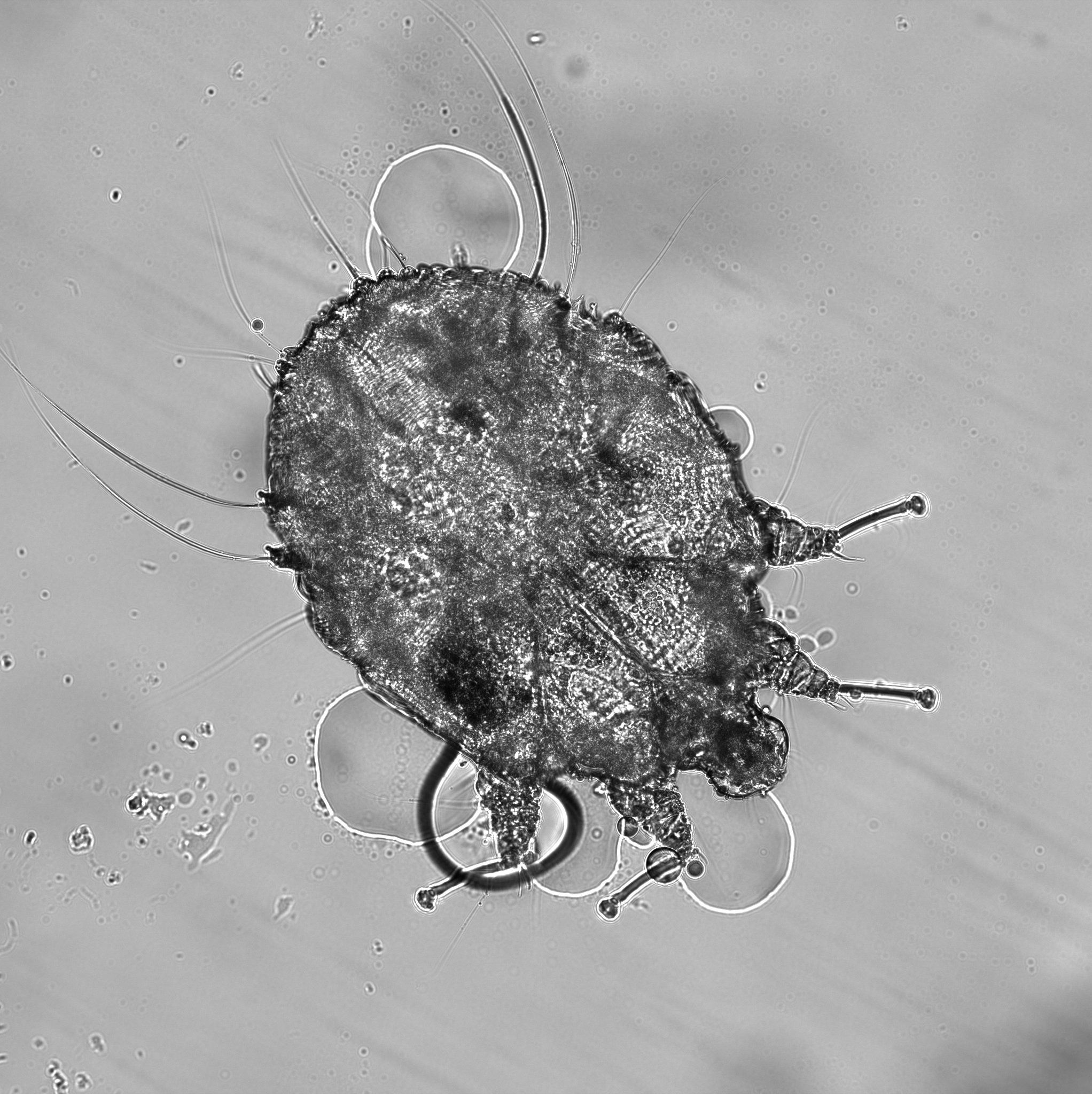
Scabies is an infestation of the outermost layer of the skin by a microscopic mite that tunnels within it and lays eggs there. The intense itch is an allergic reaction to the mite rather than damage from it, which is why it can take weeks to begin and why it continues for a while after treatment.

What is actually happening in the skin?
A mite too small to see arrives on the skin and burrows into the outermost layer, the compacted sheet of dead cells that forms the surface. There it tunnels, feeds and lays eggs. Living tissue is never reached, and the whole of scabies happens within a layer thinner than a sheet of paper.
The itch has a different origin, and this is the part worth understanding. Scabies does not itch because something is burrowing; it itches because the immune system reacts to the mite, its eggs and its waste. That reaction has to be learned before it can happen.
The consequence is a delay that catches everybody out. Somebody encountering the mite for the first time can carry it for weeks before anything itches at all, and during that entirely comfortable period they can pass it on. A person who has had scabies before reacts far faster, because the sensitisation is already in place.
Transmission needs prolonged skin-to-skin contact rather than a passing touch. That is why scabies moves through households, couples and care settings rather than through casual encounters, and why brief contact is a much smaller consideration than sustained contact.
How would a dermatologist describe it?
A burrow is the tunnel itself, and finding one is the most specific thing an examination can achieve. Described as a fine, slightly irregular line, sometimes with a dot at one end, it is what a clinician searches for with a dermatoscope.
Excoriation refers to the marks left by scratching, and in scabies they frequently dominate the picture. A clinician is looking past them for the burrows underneath, which is one reason the examination takes longer than the appearance seems to warrant.
Distribution is described with unusual precision here. Finger webs, wrists, armpits and the waistline are the classically described sites in adults, while infants and elderly people can be affected in places adults are not, including the palms, soles and scalp. That difference changes where a clinician looks.
Crusted scabies is a distinct and much less common presentation, recognised as behaving differently and managed differently. Naming it here is deliberate, because it is treated as its own situation rather than as a severe version of the usual one.
What usually happens at a consultation?
The history covers when the itch began, whether it is worse at night, who else in the household or close contact has anything similar, and what has already been applied to the skin. Questions about other people are not intrusive; scabies is a shared problem by nature.
The examination is more thorough than people expect and covers areas you did not come about. Finger webs and wrists get looked at specifically, and a dermatoscope is often used, because a burrow found is worth more than any amount of description.
Confirmation sometimes involves taking material from the skin to examine under a microscope. That is quick, needs no anaesthetic, and is described in its own page on this site.
Expect the conversation to extend to people who are not in the room. Who else needs including is a decision that follows published guidance, and it belongs with the clinician rather than with a website.
What is worth asking?
Ask whether the clinician found a burrow or is going on the pattern. The answer tells you how confident the assessment is, and confidence is worth knowing when a treatment involves other people.
Ask exactly who should be included, and when. This is the part that determines whether scabies returns, and it is far easier to get right in the room than to reconstruct afterwards.
Ask how long itching is expected to continue once treatment is complete. Without that reference point, an entirely normal recovery reads as a failure, and people repeat treatments that were never needed.
Raise clothing and bedding before you leave. Practical instructions vary, they come from published guidance rather than from folklore, and the clinician can give you the version that applies.
What this page does not do
Nothing here tells you whether your itch is scabies. Several conditions itch intensely at night and look similar once scratched, and separating them needs an examination. No treatment is named, and no application, quantity or interval appears anywhere on this page.
Common questions
Does scabies mean somebody is not clean?
No, and this is the misconception that causes most of the distress around it. The mite passes by prolonged skin-to-skin contact and has nothing to do with washing. Scabies appears in every kind of household, and treating it as a hygiene problem delays people from seeking help.
Why does the itch start so long after contact?
Because the itch is an immune response rather than a direct injury, and the immune system takes time to become sensitised to the mite. Somebody meeting it for the first time can carry mites for weeks before anything itches, which is precisely why contacts are considered even when they have no symptoms.
Why does everyone in the house need treating?
Because that delay means household members can be affected without knowing it, and treating only the person who itches leaves an untreated reservoir that returns. The published guidance on who to include is specific, and it belongs with the clinician arranging it.
Does itching afterwards mean it has not worked?
Not necessarily. The reaction to mite material can continue for some weeks after the mites are gone, which is expected rather than a sign of failure. A clinician will tell you what to watch for and when that assumption stops holding.
Can it be seen without a microscope?
The burrows are sometimes visible as fine irregular lines, and a dermatoscope makes them easier to find. Confirmation usually involves examining material taken from the skin, which is a quick procedure described elsewhere on this site.
Sources
- Scabies — NHS (United Kingdom) · accessed
- Patient information on skin conditions — British Association of Dermatologists (United Kingdom) · accessed
Last updated . How this page was written.